
For decades, global packaging strategies have been built around a relatively simple objective: standardize wherever possible.
One product. One packaging specification. One supplier strategy. One global platform.
The logic is compelling. Standardization reduces complexity, increases purchasing leverage, simplifies manufacturing and allows packaging development costs to be spread across larger volumes.
But the regulatory environment around packaging is changing.
Europe and the United States are increasingly developing two fundamentally different approaches to packaging regulation. And as those systems evolve, companies are discovering that packaging portfolios designed for global standardization may no longer be optimized for the markets they serve.
The question is therefore changing.
It is no longer simply:
“How can we standardize our packaging globally?”
It is becoming:
“Where should we standardize — and where should we deliberately differentiate?”
That distinction could become one of the defining packaging strategy questions of the next decade.
One portfolio. Two regulatory environments
A packaging component does not change when it crosses the Atlantic.
The regulatory context around it does.
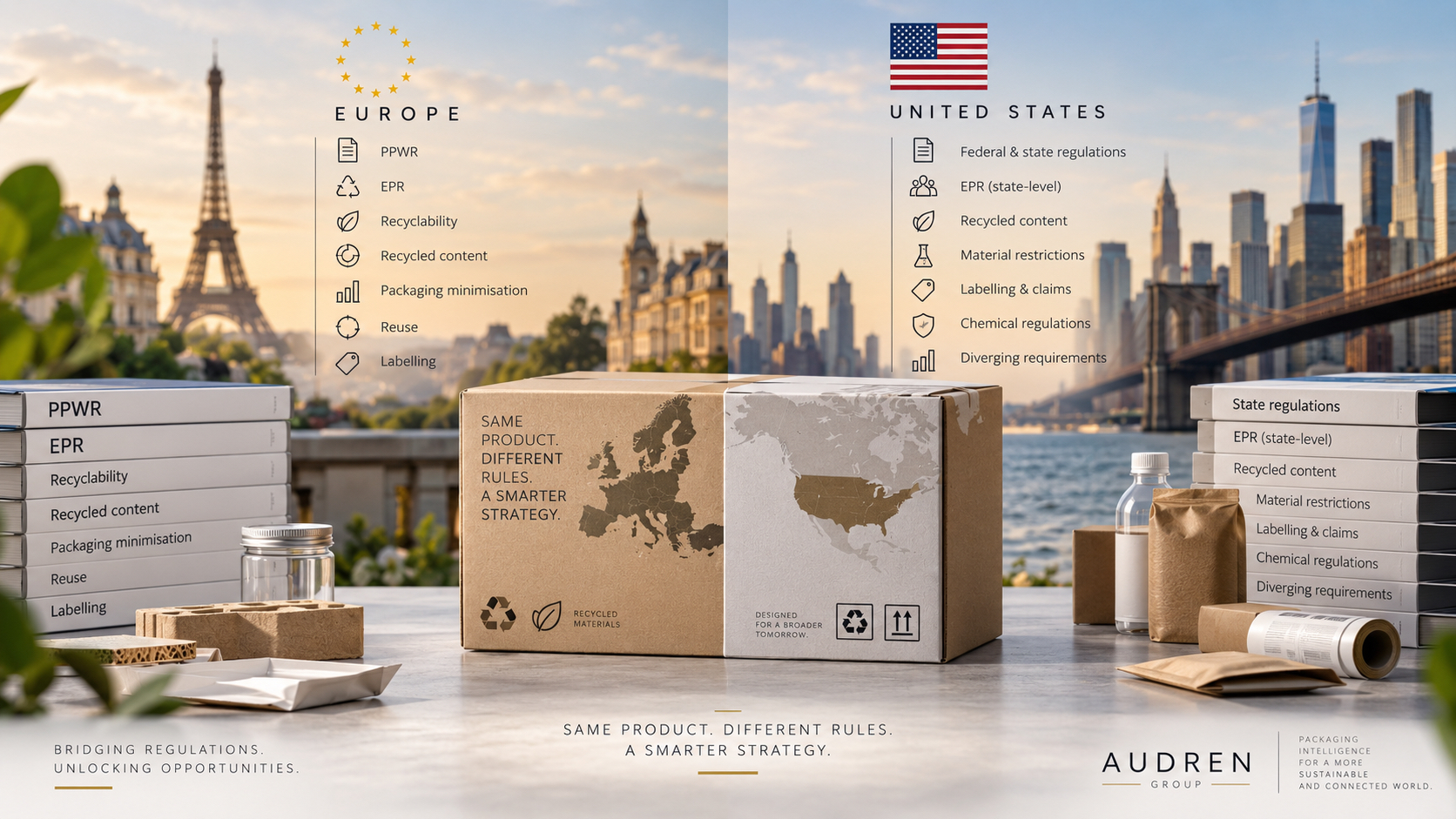
In Europe, packaging regulation is increasingly being shaped by a highly structured circular-economy framework. The Packaging and Packaging Waste Regulation — PPWR — introduces requirements and mechanisms addressing areas such as recyclability, recycled content, packaging minimization, reuse and packaging waste.
At the same time, Extended Producer Responsibility systems create economic consequences around the packaging companies place on individual European markets.
The United States is evolving differently.
Instead of one equivalent national framework, companies must navigate a combination of federal requirements and an expanding landscape of state-level packaging legislation. EPR programs, recycled-content requirements, restrictions on certain substances, labeling rules and environmental claims can vary significantly between jurisdictions.
The result is a strategic reality that global organizations increasingly need to acknowledge:
The same packaging portfolio is operating inside two different regulatory systems.
And those systems do not necessarily reward the same packaging decisions.
Global standardization is no longer automatically global optimization
Standardization remains extremely valuable.
The mistake would be to conclude that companies should create completely different packaging portfolios for Europe and the United States.
That would replace regulatory complexity with operational complexity.
But the opposite assumption — that every packaging component should remain identical globally — can be equally problematic.
Consider a company selling the same product on both sides of the Atlantic.
Its packaging may contain several components:
a primary container, a closure, a label, an adhesive, a secondary carton, protective elements and transport packaging.
Historically, the organization may have tried to harmonize those components across markets.
But increasingly, each component can interact differently with local regulatory requirements, recycling infrastructure, EPR economics, material availability and consumer expectations.
A material architecture optimized for one market may create unnecessary regulatory exposure in another.
A packaging format that performs perfectly well operationally may become economically inefficient under a particular EPR system.
A globally standardized component may require redesign because of requirements affecting only part of the portfolio.
And a redesign made for Europe may create no equivalent value in the United States — or vice versa.
The challenge is therefore not simply regulatory compliance.
It is packaging architecture.
The SKU is often the wrong level at which to think
Many companies still manage packaging primarily at the finished-product or SKU level.
But regulatory change increasingly requires a more granular understanding of the portfolio.
A single SKU may contain multiple packaging levels and multiple components, each made from different materials and potentially sourced from different suppliers.
Those same components may also be shared across dozens, hundreds or even thousands of SKUs.
This creates an important strategic distinction.
Instead of asking:
“Which SKUs need to change?”
companies should increasingly be able to ask:
“Which packaging components create the greatest exposure across our portfolio?”
That change in perspective can dramatically alter the economics of packaging transformation.
Imagine one closure used across 180 SKUs.
Or one label construction shared across several product families.
Or one secondary packaging format deployed across multiple factories.
Changing the right shared component may solve a problem across a significant portion of the portfolio.
Changing individual SKUs one by one may create years of unnecessary engineering work.
This is why the future of global packaging strategy will increasingly depend on understanding the architecture and relationships inside the portfolio, rather than treating every finished package as an isolated object.
Not every difference should trigger a redesign
There is another danger.
As regulation becomes more complex, organizations can become overly reactive.
A new requirement appears in Europe.
A team creates a European packaging variant.
A state introduces a new requirement in the United States.
Another variant appears.
A supplier proposes an alternative material.
Another specification is created.
Over time, regulatory adaptation can quietly become portfolio proliferation:
More specifications;
More components;
More suppliers;
More qualification work;
More inventory;
More artwork;
More manufacturing complexity;
And eventually, more cost.
The objective should therefore not be maximum localization.
It should be controlled differentiation.
For every potential divergence between Europe and the United States, companies should understand whether the difference creates sufficient regulatory, economic, environmental or operational value to justify the additional complexity.
Sometimes the right answer will be one global specification.
Sometimes it will be two regional specifications.
And sometimes the best solution will be a common packaging platform with a small number of market-specific components.
The important point is that these should become deliberate architectural decisions, rather than accumulated reactions to individual regulatory requirements.
The emerging model: a global core with regional adaptation
A more resilient packaging strategy can be built around a different principle:
Standardize the packaging architecture where it creates value. Differentiate only where the market requires it or where the business case justifies it.
This creates the possibility of a global core with controlled regional adaptation.
Certain elements might remain globally standardized because they provide manufacturing efficiency, purchasing leverage or technical consistency.
Others may be designed with predefined regional alternatives.
And some components may need to remain market-specific because regulation, infrastructure or economics make global harmonization impractical.
This approach moves packaging strategy away from the binary choice between:
global standardization
and
local customization.
Instead, companies can design packaging portfolios intentionally around different levels of commonality.
That is a much more powerful architectural model.
Regulation is only one variable
The danger of treating this purely as a compliance problem is that regulation becomes the only decision criterion.
Packaging decisions rarely work that way.
A technically compliant alternative may increase cost significantly.
A recyclable material may require new equipment.
A lightweight design may reduce material consumption but increase product damage.
A new structure may improve European regulatory positioning while creating sourcing complexity in the United States.
A regional specification may reduce EPR exposure while reducing global purchasing leverage.
Packaging architecture therefore needs to consider multiple dimensions simultaneously:
regulation, cost, sustainability, engineering performance, sourcing, manufacturing, logistics and commercial requirements.
This is why packaging transformation increasingly belongs at the intersection of engineering and business strategy.
The best regulatory solution is not necessarily the best packaging solution.
The objective is to identify the best overall portfolio decision.
The data challenge behind transatlantic packaging strategy
There is, however, a fundamental prerequisite.
Companies cannot optimize a packaging portfolio they cannot clearly see.
For many organizations, packaging information remains distributed across specification systems, ERP records, spreadsheets, supplier documents, sustainability databases, artwork systems and individual teams.
Before deciding whether a component should be standardized or regionalized, companies need to understand:
What is the component?
What material is it made from?
Where is it used?
Which SKUs depend on it?
Which supplier provides it?
In which markets is it placed?
What evidence supports its technical and environmental characteristics?
What happens elsewhere in the portfolio if it changes?
Without that foundation, regulatory adaptation becomes a sequence of isolated projects.
With it, companies can begin treating packaging as a connected portfolio.
And that changes the nature of the decisions they can make.
From regulatory reaction to portfolio intelligence
The next generation of packaging management will require companies to connect three capabilities that have historically been separated.
Packaging engineering provides an understanding of materials, performance, manufacturing and technical feasibility.
Regulatory intelligence explains what different markets require and how those requirements are evolving.
Portfolio intelligence reveals where components are used, how they are connected and what the business consequences of changing them could be.
Connecting those capabilities makes much more sophisticated questions possible:
Which packaging components create the greatest regulatory exposure in Europe?
Which components could remain globally standardized?
Where would regional differentiation reduce regulatory or EPR exposure enough to justify additional complexity?
Which redesign could affect the largest number of SKUs?
Which European packaging innovations could create value in the United States even before regulation requires them?
And where is the organization maintaining multiple specifications without a meaningful business reason?
These are not traditional compliance questions.
They are portfolio strategy questions.
Europe and the United States should not be managed in isolation
There is another opportunity hidden inside the divergence.
Companies often treat European and US packaging regulation as two separate workstreams.
European teams monitor European regulation.
US teams monitor US regulation.
Different consultants may be involved. Different datasets may be maintained. Different packaging projects emerge.
But multinational organizations operate one business.
Decisions made in Europe can influence sourcing, tooling, suppliers, specifications and innovation pipelines globally.
Likewise, developments in US states can affect packaging architectures originally designed around European requirements.
Managing the two systems independently risks missing opportunities for convergence.
A better approach is to ask continuously:
What should remain global?
What should become regional?
What can one market learn from the other?
That is fundamentally different from simply monitoring two sets of regulations.
It is a transatlantic packaging strategy.
Packaging portfolios need to be designed for change
Perhaps the biggest shift is that companies should stop thinking about regulatory adaptation as a one-time transformation.
PPWR will not be the final change to European packaging regulation.
The current wave of US state-level packaging legislation will not be the final change in the United States.
Materials will evolve.
Recycling technologies will evolve.
EPR economics will evolve.
Supply chains will evolve.
And corporate sustainability priorities will evolve.
The most resilient packaging portfolio will therefore not necessarily be the one that is perfectly optimized against today’s requirements.
It will be the one that can adapt efficiently as those requirements change.
That means understanding common components.
Maintaining reliable packaging data.
Knowing dependencies between SKUs and specifications.
Preserving evidence behind important packaging decisions.
And designing regional flexibility into the portfolio where it makes strategic sense.
In other words, regulatory resilience needs to become part of packaging architecture itself.
A new question for global packaging leaders
For years, packaging organizations have pursued global harmonization.
That objective remains valuable.
But the regulatory divergence between Europe and the United States means harmonization can no longer be treated as an objective in itself.
The better question is:
Where does global standardization create value — and where does regulatory divergence justify deliberate differentiation?
Companies that can answer that question at portfolio level will be better positioned to manage regulatory change without creating unnecessary complexity.
Because the future is unlikely to be one global packaging specification.
Nor should it become hundreds of disconnected local ones.
The opportunity lies somewhere between the two:
a globally coherent packaging architecture designed to adapt intelligently to different markets.
The AUDREN Perspective
At AUDREN, we believe the growing divergence between European and US packaging regulation requires a new approach to global packaging strategy.
Companies need more than regulatory monitoring. They need to understand how regulation interacts with packaging engineering, portfolio architecture, data, cost, sustainability and operational complexity.
That means moving from reactive market-by-market compliance toward deliberate portfolio decisions supported by trusted packaging information.
The objective is not to create separate European and American packaging worlds.
It is to determine intelligently what should remain common, what should change, and why.
One packaging portfolio. Two fundamentally different regulatory environments. One coherent strategy.