
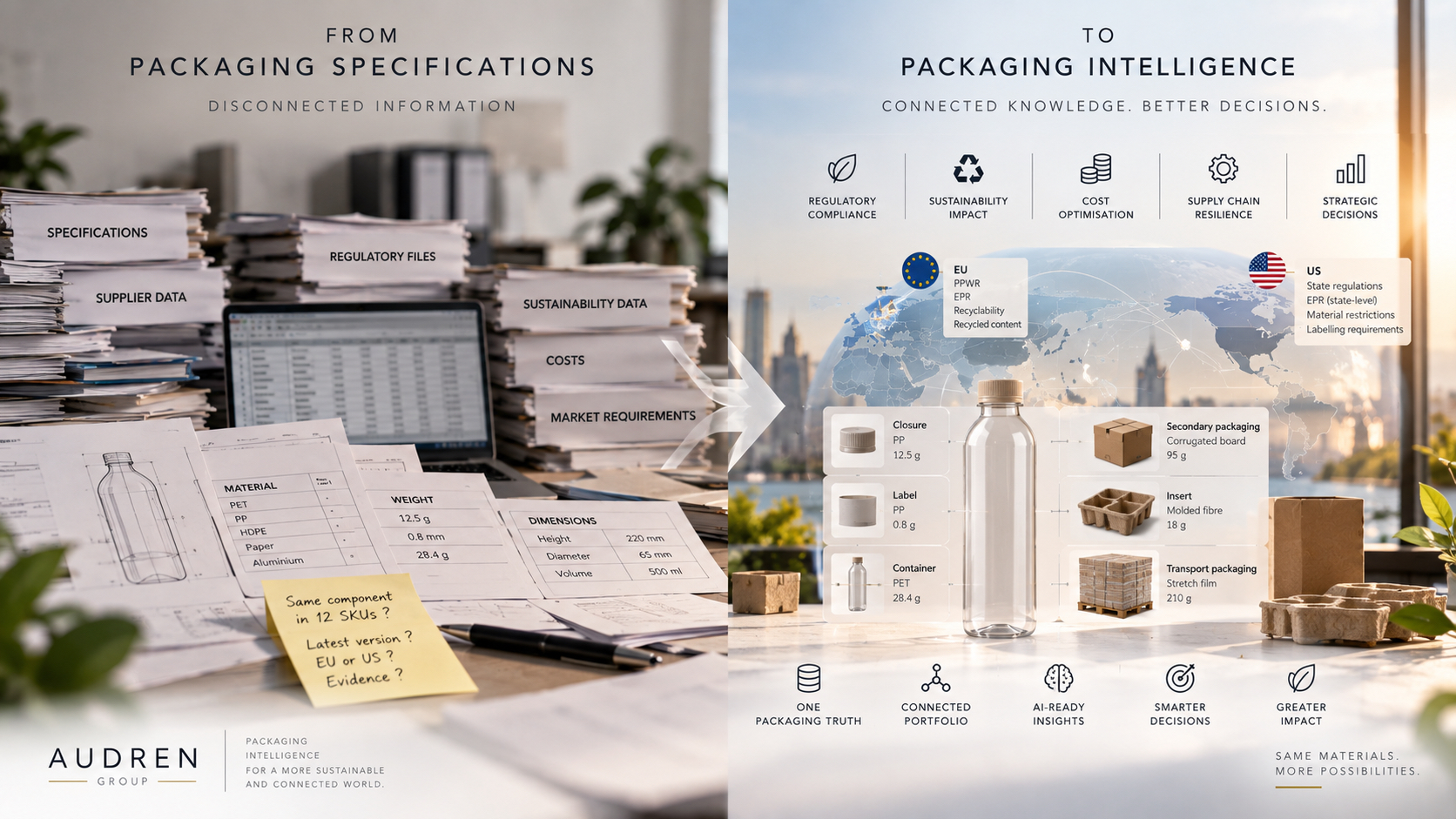
For decades, companies have managed packaging through specifications.
A specification describes what a package is supposed to be: its dimensions, materials, weight, performance requirements, supplier references, artwork constraints and technical characteristics.
Specifications are essential. They provide the technical foundation required to manufacture, purchase and control packaging.
But they were designed primarily to answer a relatively simple question:
“What is this packaging?”
The questions companies need to answer today are becoming much more complex:
Which packaging components create the greatest regulatory exposure across our portfolio?
Where are we using similar materials under different specifications?
Which products would be affected if a supplier changed a material?
Where could we reduce packaging without compromising performance?
Which packaging formats will require action under emerging regulations?
What would happen to cost, carbon footprint, recyclability and sourcing risk if we changed a component?
And increasingly:
What should we change first?
A collection of specifications cannot answer these questions on its own.
To do that, companies need to move from managing packaging specifications to building packaging intelligence.
A specification is a document. Packaging is a system
The fundamental limitation of traditional specification management is not that specifications are inadequate.
It is that packaging decisions increasingly depend on the relationships between specifications.
Consider a relatively simple consumer product.
Its packaging system might include a primary container, closure, label, adhesive, secondary carton, protective insert, corrugated transport case and pallet configuration.
Each component may have its own specification;
Each may come from a different supplier;
Each may contain several materials;
And the same component may be shared across dozens or hundreds of products.
Now add markets.
The packaging may be sold in France, Germany, the United States and Canada.
Add regulatory requirements;
Add EPR obligations;
Add recycled-content targets;
Add recyclability assessments;
Add costs;
Add environmental data;
Add supplier evidence;
Add performance tests.
The packaging specification remains important.
But the business question is no longer contained inside one specification.
It exists in the connections between all of these elements.
That distinction is fundamental.
Companies often have packaging data without packaging knowledge
Most large organizations already possess enormous amounts of packaging information.
The problem is rarely the complete absence of data.
The problem is that the information is fragmented:
Dimensions may exist in a specification management system;
Material composition may be stored in an Excel file maintained by sustainability teams;
Costs may sit inside ERP systems;
Recyclability assessments may exist in external reports;
Supplier declarations may arrive as PDFs;
Testing information may remain with engineering teams;
Regulatory assessments may be maintained in another spreadsheet;
Artwork information may exist in a separate platform;
And important knowledge may still live in emails — or simply in the experience of individual packaging engineers.
Each source can be perfectly legitimate.
But collectively they create a problem.
The company has packaging information.
It does not necessarily have structured packaging knowledge.
And without structured knowledge, many seemingly simple questions become surprisingly difficult to answer.
The missing layer is context
A number has limited value without context.
Consider: 12.5 g
What does it mean?
Is it the weight of a component?
Which component?
Which version?
For which SKU?
Measured by whom?
When?
Is it a supplier declaration or an internal measurement?
Does it include the label?
Which market does it apply to?
Has it been verified?
Is there evidence supporting it?
Is another system storing 13.1 g for the same component?
This is why packaging intelligence requires more than collecting data into a database.
Each important packaging fact needs to exist within a structure that explains what it describes, where it came from, how reliable it is and how it relates to the rest of the portfolio.
The difference is significant.
Data tells you that a value exists. Knowledge tells you what that value means.
And intelligence begins when that knowledge can support decisions.
Packaging needs a common language
One of the biggest barriers to packaging intelligence is inconsistency.
Different teams describe the same things differently:
One database might use “PET”, another “Polyethylene terephthalate”, another “PET clear”, and another “PET bottle”;
A supplier spreadsheet might report thickness in microns;
An American specification might use mils, while a European engineering file might use millimetres;
Weights might be recorded in grams, ounces or pounds;
Dates may follow different conventions;
Material categories may vary between suppliers, business units and regulatory systems.
None of these differences is particularly difficult individually.
At portfolio scale, however, they become significant.
Before packaging data can support sophisticated analysis, companies need a way to translate these different representations into a common packaging language while preserving the original information.
That means normalization.
But importantly, normalization should not mean erasing the source.
If a supplier provided a value in ounces, the original value should remain traceable even if the system converts it into a canonical metric value for calculation.
If two sources disagree, one should not silently overwrite the other.
If a value cannot be interpreted confidently, uncertainty should remain visible.
That discipline is essential because packaging intelligence depends on trust.
The portfolio becomes more valuable than the individual specification
Once packaging information is structured and connected, something important happens.
The unit of analysis changes.
Instead of looking only at one specification, companies can begin examining the portfolio as a system.
Imagine discovering that 14 apparently different packaging specifications actually use nearly identical components.
Or that one closure is shared across 240 SKUs.
Or that 60% of a portfolio’s regulatory exposure comes from a relatively small number of material architectures.
Or that several suppliers provide functionally equivalent components under different internal descriptions.
Suddenly, packaging optimization becomes much more strategic.
A company can move from:
“How do we improve this package?”
to:
“Where can one packaging decision create the greatest value across the portfolio?”
That is a fundamentally different capability.
Structured knowledge changes regulatory management
This becomes particularly important as packaging regulation becomes more complex.
A regulation rarely affects a company simply because a SKU exists.
It affects specific characteristics of the packaging associated with that SKU:
Material composition;
Packaging format;
Weight;
Recycled content;
Recyclability;
Market;
Packaging level;
Function;
Sometimes the presence or absence of a particular substance or component.
The more structured the underlying packaging knowledge becomes, the more precisely companies can connect regulatory requirements to the packaging portfolio.
Instead of asking thousands of products individually:
“Are we compliant?”
organizations can begin asking:
“Which components, materials and packaging architectures are potentially affected by this requirement — and which SKUs depend on them?”
That can dramatically change the way regulatory transformation is managed.
Compliance becomes less about repeatedly collecting information and more about understanding the architecture of the portfolio.
The same applies to sustainability
Sustainability analysis often suffers from the same fragmentation.
Companies may calculate packaging weight, recycled content, recyclability, carbon impact or material consumption independently.
But these indicators become much more powerful when they are connected to the underlying packaging architecture.
A company could identify not simply how much plastic it uses, but:
Which components drive that consumption?
Which products depend on them?
Which suppliers provide them?
Which alternatives exist?
Which markets are affected?
And what other consequences a material change might create?
This is the difference between reporting sustainability metrics and using sustainability information to make better packaging decisions.
AI increases the value of structured packaging knowledge
Artificial intelligence makes this transformation even more important.
Generative AI makes it possible to interact with information in ways that would have seemed unrealistic only a few years ago.
Executives may increasingly expect to ask questions such as:
“Which packaging components should we prioritize for redesign in Europe?”
or:
“Where can we reduce material consumption without creating significant regulatory or sourcing risk?”
The interface is becoming easy.
The difficult part is everything underneath it.
An AI system cannot reliably answer those questions simply because thousands of packaging documents have been placed into a repository:
It needs to understand what the information represents;
It needs relationships;
It needs provenance;
It needs consistent units;
It needs evidence;
It needs to distinguish current information from obsolete information;
It needs to know when two sources disagree;
And critically, it needs to know when the available data is not sufficient to support the requested decision.
This leads to an important principle:
The future value of AI in packaging will depend less on the ability to generate answers than on the quality of the packaging knowledge behind those answers.
The competitive advantage therefore begins before the AI layer.
It begins with the structure of the knowledge itself.
From system of record to system of intelligence
Companies already operate numerous systems of record:
ERP systems manage transactions;
PLM systems manage product information;
Specification platforms manage technical specifications;
Supplier systems manage procurement relationships;
Sustainability platforms manage environmental information.
These systems remain necessary.
Packaging intelligence does not necessarily require replacing them.
The opportunity is to create a layer capable of connecting and interpreting packaging knowledge across them.
That layer can understand that:
a material belongs to a component;
a component belongs to a packaging level;
a packaging level belongs to a packaging system;
that packaging system is used by several SKUs;
those SKUs are sold in particular markets;
specific regulatory requirements apply in those markets;
supplier evidence supports certain material characteristics;
and changing one component may therefore affect many products and decisions.
The value lies in the relationships.
That is why the transition from specifications to intelligence is not simply another digitization project.
It represents a different way of modelling packaging itself.
Packaging knowledge can become cumulative
There is another important consequence.
Traditional packaging projects often generate knowledge that is used once and then partially lost:
A team investigates a material;
An engineer qualifies a supplier;
A consultant assesses a regulation;
A sustainability team evaluates recyclability;
A redesign project compares alternatives;
A decision is made;
Months later, another team may investigate many of the same questions again.
Structured packaging knowledge changes this dynamic.
Evidence can remain connected to the relevant component.
Previous decisions can remain traceable.
Supplier information can be reused.
Material knowledge can accumulate.
Regulatory assessments can be updated rather than reconstructed.
Relationships discovered during one analysis can support another.
In other words:
Packaging knowledge can become a reusable corporate asset rather than a temporary project output.
And the larger and more complex the packaging portfolio becomes, the more valuable that asset can become.
From visibility to decision intelligence
The ultimate objective is not to create beautiful packaging dashboards.
Visibility is useful.
But visibility alone does not create competitive advantage.
The real opportunity is to progressively connect packaging knowledge with decision models.
Imagine a company considering a packaging redesign.
Today, different teams may independently evaluate:
Technical feasibility;
Cost;
Regulatory implications;
Recyclability;
Carbon impact;
Supplier availability;
Manufacturing compatibility;
Logistics;
And implementation complexity.
Packaging intelligence can progressively bring these dimensions together.
The organization could compare scenarios rather than isolated metrics.
Option A might reduce cost but increase regulatory exposure.
Option B might improve recyclability but require capital expenditure.
Option C might increase material cost slightly while reducing EPR fees and simplifying the portfolio.
The important output is no longer another piece of packaging data.
It is an understanding of the trade-offs behind the decision.
That is where packaging intelligence begins to influence strategy.
Why this can become a competitive advantage
Two companies can have access to the same packaging materials:
The same suppliers;
The same regulations;
The same recycling technologies;
And increasingly, the same AI models.
What will differentiate them is how effectively they can convert those inputs into decisions.
The company that understands its packaging portfolio better can potentially identify regulatory risks earlier:
It can prioritize redesign more intelligently;
It can reuse engineering knowledge;
It can identify unnecessary complexity;
It can compare alternatives faster;
It can respond more quickly when regulations change;
And it can make decisions using evidence that already exists rather than repeatedly rebuilding the same knowledge.
That creates something competitors cannot reproduce simply by purchasing another software licence.
It creates organizational packaging intelligence.
The next packaging capability
For years, packaging excellence has largely depended on engineering expertise.
That will remain essential:
Materials still need to perform;
Packages still need to protect products;
Manufacturing lines still need to run;
Supply chains still need to work;
But engineering expertise will increasingly be amplified by another capability:
the ability to structure, connect and reuse packaging knowledge across the organization.
The companies that develop that capability will not simply know more about their packaging.
They will be able to make better decisions from what they know.
And as regulatory complexity, sustainability requirements, supply-chain pressure and AI adoption continue to increase, that difference could become increasingly significant.
The evolution therefore looks less like:
Specifications → More specifications → Better databases
and more like:
Specifications → Structured knowledge → Packaging intelligence → Better decisions
The specification remains the foundation.
But it is no longer the destination.
The AUDREN Perspective
At AUDREN, we believe packaging data should evolve from a collection of disconnected technical records into a trusted, structured and reusable knowledge asset.
That requires more than centralizing files.
Packaging information needs to be connected to products, components, materials, suppliers, markets, regulations, evidence and decisions — while preserving provenance and uncertainty.
This foundation is particularly important for companies operating across Europe and the United States, where the same packaging portfolio increasingly needs to be understood through different regulatory and market contexts.
The next competitive advantage in packaging will not come simply from having more data.
Nor will it come simply from adding AI.
It will come from combining packaging expertise, trusted data and structured knowledge to understand portfolios more deeply and make better decisions.
Because the future of packaging intelligence starts with knowing not only what your packaging is — but how everything connects.